 Written by
 In the industrial sector, choosing the right sealing material is crucial for equipment safety and reliable operation. Graphite gaskets are a highly efficient and dependable sealing solution, widely used in complex industrial environments due to their superior performance. This article explores their advantages, application scenarios, and comparison with metal-jacketed gaskets to provide a comprehensive understanding of this essential industrial material.
Outstanding Performance of Graphite Gaskets
Graphite gaskets are designed for reliable sealing across a wide range of media, including water, steam, oil, hydrogen, and chlorine. Their unique structure and material properties ensure minimal leakage, protect equipment, and maintain operational safety.
- Elasticity and Flexibility
Graphite gaskets provide elasticity, allowing them to act as shock absorbers and reduce vibrations. This capability minimizes noise and extends the service life of machinery, improving overall operational efficiency. - Corrosion Resistance
The exceptional corrosion resistance of graphite gaskets prevents damage from aggressive chemicals, reducing maintenance frequency and prolonging equipment lifespan. This feature is particularly valuable in chemical and pharmaceutical industries. - Electrical Conductivity
Graphite gaskets possess moderate electrical conductivity, making them suitable for applications that require conductive sealing, such as electronic devices or equipment with conductive connections. - High-Temperature Performance
Graphite gaskets maintain sealing integrity under high-temperature conditions, with excellent heat resistance and fireproof properties. They are commonly used in boilers, generators, and other high-temperature equipment to prevent leaks and enhance safety.
Types and Applications of Flexible Graphite Gaskets
Flexible graphite gaskets are made from graphite sheets, sometimes reinforced with metal, and are categorized into several types:
- Flexible Graphite Gasket: Simple sheets, ideal for pipeline flanges and valve covers.
- Flexible Graphite Gasket MI: Graphite sheets reinforced with a carbon steel layer for enhanced mechanical strength.
- Flexible Graphite Gasket PM: Graphite bonded to 304 stainless steel for durability and easy handling.
- Flexible Graphite Gasket PM-A: Similar to PM but reinforced with 316 stainless steel for superior performance.
Innovative Graphite Composite Gaskets
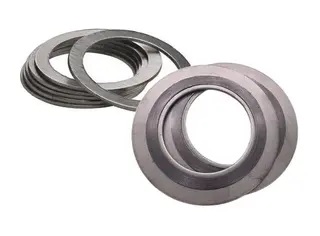
Graphite composite gaskets combine graphite with perforated metal plates or wire mesh to enhance strength and functionality.
- Structural Features
They are reinforced with materials like SS304, SS316, or tinplate, offering high compressive strength and durability. - Functional Features
Composite gaskets maintain excellent corrosion resistance, high/low-temperature tolerance, and rebound strength while requiring lower preloading force and flange surface quality. - Edge-Wrapping Design
Some composite gaskets include edge-wrapping to facilitate installation and prevent damage or external corrosion. - Structural Types
Available in RF, MFM, and TG designs for different flange connections, with optional stainless or carbon steel wrapping (RF-E types) to enhance performance.
Wide Industrial Applications
Graphite composite gaskets are extensively used across industries:
- Chemical Industry: Sealing reactors, pipelines, and containers; prevents corrosion and leaks.
- Petroleum Industry: Ideal for high-pressure, high-temperature, and corrosive environments; reduces oil leaks and environmental hazards.
- Pharmaceutical Industry: Maintains hygiene and prevents contamination during production.
- Food Industry: Ensures safe and leak-free sealing in processing and packaging.
- Power Industry: Reliable high-temperature and fireproof sealing for generators and transmission equipment.
Comparison: Graphite vs. Metal-Wound Gaskets
- Chemical Composition & Properties: Graphite gaskets are flexible and conductive, with excellent pressure and temperature resistance. Metal-wound gaskets combine metal strips and fillers (graphite, PTFE, or fluoroelastomers) for elasticity and adaptability.
- Performance: Graphite gaskets excel in high-pressure, high-temperature environments but have limited sealing for specialized pipelines. Metal-wound gaskets offer superior sealing versatility but may have lower pressure resistance.
- Applications: Graphite gaskets are preferred in petrochemical, aerospace, and boiler systems, while metal-wound gaskets are common in chemical and petroleum industries requiring adaptable sealing solutions.
Conclusion
Graphite gaskets and their composite forms are essential for reliable industrial sealing. They offer excellent sealing performance, corrosion resistance, and high-temperature tolerance. Composite gaskets further enhance these properties through metal reinforcement. Across chemical, petrochemical, pharmaceutical, food, and power industries, graphite gaskets provide a safe, efficient, and durable sealing solution, ensuring the smooth operation of critical equipment.It’s important to know about Google SEO to help your website rank higher in search results.

 Written by
 Written by