 Written by
 Maximizing production efficiency often comes down to how effectively products are moved from one level to another. For facilities with limited space or high throughput demands, the choice between a spiral and an incline conveyor can significantly impact operational flow. Many spiral freezer manufacturers and packaging facilities rely on vertical conveyors to optimize movement while minimizing the loss of valuable floor space and maintaining product integrity.
Both spiral and incline conveyors serve the same purpose—vertical transport—but their designs, capacities, and footprints differ greatly. Understanding these distinctions is essential for choosing a solution that meets space constraints, speed requirements, and material handling demands.
Understanding the Basics: Spiral vs. Incline Conveyors
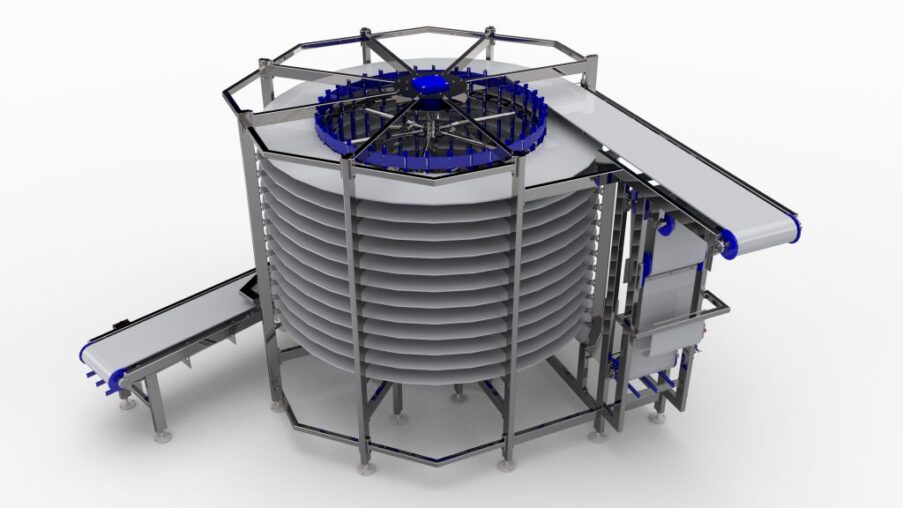
A spiral conveyor moves products in a continuous upward or downward motion using a helical belt path wrapped around a central column. It’s ideal for compact facilities needing continuous flow between different elevations.
On the other hand, inclined conveyors use a straight belt angled upward or downward to transport products between levels. These systems are simpler in design but typically require more horizontal space, making them less suited for tightly packed facilities.
Comparing Design and Footprint
The key difference between the two lies in space efficiency. Spiral systems have a vertical configuration, allowing facilities to move products over significant height differences within a small footprint. Incline conveyors, however, need more length to achieve the same height transition.
When floor space is limited, a spiral system offers a more efficient solution. However, if space isn’t a concern and maintenance simplicity is a priority, incline conveyors can be an economical choice.
Speed, Throughput, and Product Handling
In high-speed production environments, spiral conveyors are often the preferred choice. Their continuous-flow design minimizes transfer points, reducing the risk of product collisions or jams. This makes them suitable for delicate items such as packaged food, bottles, or trays.
Incline conveyors, while effective, typically handle lower throughput due to their shorter belt width and steeper angles. They are best suited for applications where speed is secondary to simplicity and cost-efficiency.
Maintenance and Durability Considerations
Maintenance requirements vary depending on system complexity. Spiral systems include multiple moving parts, including chain-driven or belt-driven mechanisms that require periodic lubrication and alignment checks. However, their enclosed design often results in less product contamination and wear.
Incline conveyors are easier to service, thanks to their straightforward belt and motor assembly. For environments prioritizing easy access and minimal maintenance downtime, incline conveyors may be a better fit.
Industry Applications and Use-Case Scenarios
Spiral systems are standard in food processing, packaging, and cold storage. Spiral cooling conveyors and spiral freezers, for example, are widely used by food producers to cool or freeze items efficiently while saving space. The pharmaceutical and beverage industries also rely on spiral conveyors for continuous, gentle handling.
Incline conveyors, conversely, are standard in manufacturing, logistics, and warehousing, where products are transferred between floors or mezzanines. They handle a diverse range of materials, from boxes to bulk components.
Cost, Energy, and Installation Factors
Incline conveyors generally cost less to install and operate due to their simpler structure. Spiral conveyors have a higher initial cost but can save money in the long term by reducing floor space requirements and improving system efficiency. Energy consumption also depends on design—spiral systems often use controlled drive motors that enhance energy efficiency during continuous operation.
Safety and Compliance Features
Safety remains a key factor in conveyor design. Spiral conveyors typically include guards, covers, and controlled start/stop mechanisms to prevent accidents. Incline conveyors can be equipped with cleated belts or side rails to ensure product stability during steep transfers. Both systems can comply with sanitary design standards for food and pharmaceutical environments when properly configured.
How to Decide Which Conveyor Is Right for the Facility
Selecting the right conveyor depends on several factors, including available space, product type, weight, speed requirements, and maintenance expectations. A detailed facility layout analysis helps determine whether a compact spiral system or a straightforward incline conveyor delivers the best operational value.
Optimize Vertical Movement with the Right Conveyor System
Both spiral and incline conveyors serve critical roles in modern manufacturing and processing environments. For compact facilities or operations involving cooling and freezing, spiral conveyor systems designed by trusted spiral conveyor manufacturers like Conovey provide efficient, space-saving vertical movement. For applications requiring simpler elevation transfers, incline conveyors remain a dependable choice.
Contact Conovey today to learn more about advanced spiral and incline conveyor solutions engineered to optimize material flow and efficiency for every industry.


 Written by
 Written by