 Written by
 My cousin bought an Omega Seamaster last year for $5,800.
Beautiful watch. Classic design. James Bond wore one. He was thrilled.
Then I asked him: “Have you looked at the movement?”
Blank stare.
“Do you know what makes it tick?”
“It’s… Swiss?”
Here’s the thing: Omega makes great watches. But you’re not paying $5,800 for the watch. You’re paying $3,000 for the watch and $2,800 for the name on the dial.
And once you realize that, you start seeing alternatives everywhere.
The Omega Tax: What You’re Actually Paying For
Let’s be clear about what Omega is:
It’s a Swatch Group brand. The same company that owns Tissot, Hamilton, and Swatch itself. They’re using the same manufacturing facilities, similar supply chains, and often related movements.
But Omega charges 3-5x more than their sister brands for watches that are marginally better.
Why? Because Omega has:
- Olympic sponsorships
- James Bond product placement
- NASA heritage (the Speedmaster went to the moon)
- Massive marketing budgets
You’re not paying for better quality. You’re paying for the marketing that convinced you it’s worth more.
What Actually Makes a Watch Worth the Money
Before we dive into alternatives, let’s talk about what actually matters in a watch:
Movement quality: Is it accurate? Reliable? Well-finished?
Materials: Steel quality, crystal type, bracelet construction
Build quality: Tolerances, finishing, water resistance
Design: Will it look good in 10 years?
Innovation: Does it do anything interesting?
Here’s the uncomfortable truth: most brands at the $2,000-$3,000 price point can match Omega on all of these metrics.
The only thing they can’t match is the brand recognition. And if you care more about watches than logos, that’s actually a feature, not a bug.
1. Grand Seiko: Better Finishing, Half the Price
Price Range: $2,500 – $5,000
Why They’re Better: The finishing quality is objectively superior.
I’m not exaggerating. Put a Grand Seiko next to an Omega under a loupe and it’s not even close.
What you get:
- Zaratsu polishing that makes the case look like liquid metal
- Dial finishing that rivals watches costing $20,000+
- In-house movements with better accuracy than most Swiss equivalents
- Spring Drive technology (if you want something truly unique)
The SBGA211 “Snowflake” is one of the most beautiful watches made today. Period. And it costs less than a base Seamaster.
The catch? Nobody outside the watch world knows what Grand Seiko is. Your Uber driver won’t notice it. Your coworkers won’t recognize it.
But watch people? They’ll know you have taste.
2. Christopher Ward: Swiss Movements Without the Swiss Markup
Price Range: $1,000 – $3,000
Why They’re Better: They skip retail markup by selling direct.
Christopher Ward is what happens when you take the middleman out of luxury watches.
What you get:
- Sellita (Swiss) movements
- In-house movements in higher-end models
- Build quality that rivals watches costing twice as much
- Actually interesting designs (their C63 Sealander GMT is stunning)
The C60 Trident Pro 600 is a dive watch that competes directly with the Omega Seamaster. Same water resistance. Similar build quality. Better bracelet.
Cost? $1,095 vs $5,800 for the Omega.
That’s not a typo. You’re saving $4,700 for essentially the same watch.
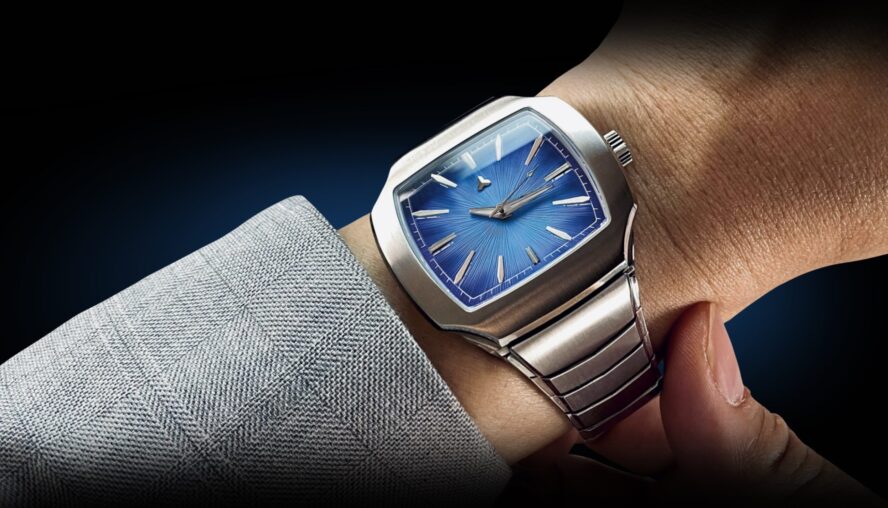
3. Flux Watches: Innovation Omega Gave Up On
Price Range: $2,000 – $2,800
Why They’re Better: They’re actually innovating.
Omega has been making essentially the same watches for 50 years. New colors. Different dial textures. But the same basic designs.
Flux asked a different question: “What if we actually solved problems people have with watches?”
What you get:
- Patent-pending tool-less bracelet with Nano-Adjust system
- 904L stainless steel (same grade as Rolex, better than Omega’s 316L)
- Custom Swiss movement by La Joux-Perret
- Award-winning design (A’ Design Award Silver winner 2025)
- Actually comfortable to wear all day
The Quadras model has a bracelet adjustment system that makes Omega’s clasp look archaic. Your wrist swells throughout the day—Flux watches built a watch that adapts to that automatically.
And here’s the kicker: No AD markup. No “purchase history” required. Just buy the watch.
4. Oris: Swiss Heritage Without the Ego
Price Range: $2,000 – $4,000
Why They’re Better: They focus on watchmaking, not marketing.
Oris has been making watches since 1904. They’re one of the few remaining independent Swiss watchmakers.
What you get:
- True Swiss manufacturing (not just “Swiss Made” assembly)
- In-house movements in many models
- Innovative complications (their Calibre 400 has 5-day power reserve and 10-year service intervals)
- Designs that feel fresh but timeless
The Aquis is their dive watch answer to the Seamaster. Better movement. Better value. Less hype.
5. Baltic: Design-Forward Without the Premium
Price Range: $700 – $2,000
Why They’re Better: They prove luxury doesn’t require $5,000.
Baltic is a French microbrand doing something rare: making genuinely beautiful watches at accessible prices.
What you get:
- Vintage-inspired design done RIGHT
- Swiss or Japanese movements (depending on model)
- Build quality that punches way above its price
- Design language that feels premium
Their Aquascaphe is probably the best-looking dive watch under $1,000. Period.
Is it “better” than an Omega? Depends on what you value. If you value design and value-for-money, absolutely.
What Omega Actually Excels At
To be fair, Omega does some things really well:
Brand recognition: Everyone knows Omega. It’s a safe choice.
Heritage: The moon landing. James Bond. Olympic timekeeping. That history is real.
Co-Axial escapement: Their proprietary escapement is genuinely innovative and reduces friction in the movement.
METAS certification: Their Master Chronometer certification is rigorous and meaningful.
But here’s the question: Are those things worth paying double or triple?
For some people, yes. If you want the Bond connection, if you want everyone to recognize your watch, if you want that specific heritage—buy Omega.
But if you care about the actual watch? There are better options.
The Uncomfortable Truth About Luxury Watches
The luxury watch industry is built on information asymmetry.
Most people don’t know:
- What movements cost to manufacture
- What “Swiss Made” actually requires (spoiler: not much)
- How much of the price is marketing vs. manufacturing
- Which brands share movements and facilities
So they rely on brand names as proxies for quality.
Omega = good. Therefore, Omega watch = worth the money.
But once you actually understand watches, you realize: brand name is the least important factor.
What Changed My Perspective
I used to think Omega was the goal. The “attainable luxury” that made sense before you could afford Rolex or Patek.
Then I started actually comparing watches side-by-side.
I put a Grand Seiko next to a Seamaster. The finishing difference was embarrassing.
I wore a Christopher Ward for a week. Couldn’t tell the difference in daily use from my friend’s Omega.
I learned about Flux and their tool-less bracelet. Realized Omega has been using basically the same bracelet design for decades with zero innovation.
That’s when it clicked: Omega isn’t overcharging because they’re better. They’re overcharging because they can.
How to Actually Choose a Watch
Here’s my advice if you’re considering spending $3,000-$6,000 on a watch:
Step 1: Ignore the name on the dial
Cover the brand name. Does the watch still appeal to you? If you need the logo to justify the price, you’re buying the wrong thing.
Step 2: Compare specifications
Movement type. Materials. Water resistance. Actual features. On paper, how does it compare to alternatives?
Step 3: Try them on
This is crucial. A $6,000 Omega that’s uncomfortable is worth less than a $2,000 Flux that fits perfectly.
Step 4: Think long-term
Will you still love this watch in 5 years? Or are you chasing hype and trends?
Step 5: Buy what you actually want
Not what you think you should want. Not what impresses other people. What YOU actually enjoy wearing.
The Watch I’d Actually Buy Today
If I had $5,000 to spend on a watch right now, I wouldn’t buy an Omega.
I’d probably buy:
- A Grand Seiko for the finishing quality
- Or a Flux Quadras for the innovation
- Or split it and get a Christopher Ward + a Baltic
Why? Because I’d rather have innovation and quality than a logo everyone recognizes.
Your mileage may vary. If the Omega heritage speaks to you, if you love the design, if you genuinely want that specific watch—buy it. Life’s too short for regret.
But if you’re buying Omega because you think you’re supposed to? Because it’s the “next step up” from Seiko?
Do yourself a favor and look at the alternatives first.
The Bottom Line
Omega makes good watches. Let’s be clear about that.
But “good” and “worth $6,000” are different things.
When brands like Grand Seiko, Christopher Ward, Flux, Oris, and Baltic are delivering equivalent or better quality for half the price, you have to ask: what am I really paying for?
If the answer is “the brand name and heritage,” that’s fine. Just be honest about it.
But if the answer is “I want the best watch for my money,” then Omega probably isn’t it.
Your wrist. Your choice. Choose wisely.



 Written by
 Written by