 Written by
 In industrial production, reliable sealing is crucial for ensuring the safe operation of equipment and preventing medium leakage. Packing, a traditional sealing material, is widely used in pumps, valves, reactors, and other machinery. Among the most common types are graphite packing and aramid fiber packing, each offering distinct performance characteristics and suited to different applications. This article provides a detailed comparison to help select the most appropriate sealing solution.
Graphite Packing: A Proven Classic
Graphite packing consists mainly of graphite, often reinforced with carbon fibers or metal wires. Its key features include:
- Excellent Self-Lubrication and Thermal Conductivity
Graphite reduces friction between the packing and the shaft or valve stem, minimizing wear and heat generation. Its high thermal conductivity dissipates heat quickly, preventing localized overheating and extending equipment life. - High Temperature and Pressure Resistance
Graphite packing can operate in extreme conditions, withstanding temperatures up to 600°C and high pressures. It is ideal for valves, pumps, and reactors handling high-temperature, high-pressure, or corrosive media. - Versatility and Strength
Flexible and adaptable, graphite packing fits various equipment types and flange shapes. It withstands significant axial pressure, maintaining sealing performance under high load conditions. - Cost-Effectiveness
Graphite packing is economical, offering broad applicability across multiple industrial environments without compromising sealing performance.
Aramid Fiber Packing: High-Performance Modern Material
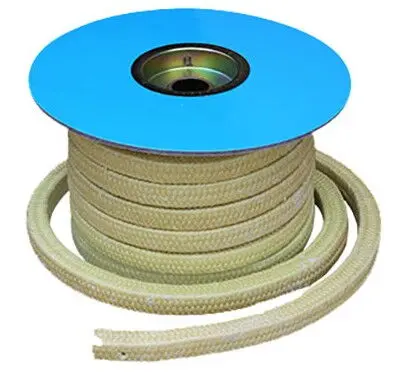
Aramid fiber packing is woven from aramid fibers and impregnated with lubricants, PTFE emulsions, or other agents, providing advanced sealing performance. Its main advantages are:
- Chemical Resistance and Resilience
Aramid fibers resist acids, alkalis, and other corrosive media. They maintain shape and elasticity over long-term use, ensuring consistent sealing performance. - Low Cold Flow and High-Speed Capability
With minimal cold flow, aramid fiber packing retains its shape under prolonged stress. It adapts well to high-speed equipment, preventing leakage in fast-moving pumps and reactors. - Wear and Temperature Resistance
Aramid fiber packing withstands particulate media, such as slurries or ash, and maintains reliable sealing under temperatures up to 230°C. - Combinability and Versatility
It can be used alone or combined with other materials to optimize sealing performance. Aramid fiber packing is suitable for abrasive media, superheated steam, solvents, liquefied gas, and even as a modern asbestos replacement.
Performance Comparison
| Feature | Graphite Packing | Aramid Fiber Packing |
|---|---|---|
| Self-lubrication | Excellent | Good |
| Thermal conductivity | Excellent | Poor, often needs reinforcement |
| High-temperature resistance | Up to 600°C | Up to 230°C |
| Chemical resistance | Good, limited against strong oxidizers | Excellent |
| Wear resistance | Good | Outstanding, especially with particulate media |
| Elasticity & resilience | Poor | High, maintains shape |
| Cold flow | Moderate | Low, minimal deformation over time |
Summary: Graphite packing excels in high-temperature, high-pressure environments with low friction, while aramid fiber packing performs better in chemically aggressive, abrasive, or high-speed applications.
Application Scenarios
- High-temperature, high-pressure equipment: Graphite packing is suitable; aramid fiber packing is limited by temperature.
- Corrosive media: Aramid fiber packing is preferred.
- Particulate media: Aramid fiber packing is superior due to wear resistance.
- High-speed equipment: Aramid fiber packing offers stable performance.
- Food, pharmaceutical, and other high-cleanliness industries: Aramid fiber packing is suitable; graphite packing may contaminate.
Cost Considerations
Graphite packing is low-cost and suitable for projects with strict budget constraints. Aramid fiber packing has a higher initial cost but offers a longer service life—up to 4–20 times that of graphite packing—reducing maintenance and replacement expenses, particularly in continuous industrial operations.
Choosing the Right Packing
Selection should consider operating conditions, medium properties, and budget:
- High-temperature, high-pressure environments: Graphite packing is reliable.
- Particulate or abrasive media: Aramid fiber packing is preferred.
- High-speed equipment: Aramid fiber packing ensures stable sealing.
- Corrosive media: Aramid fiber packing is ideal.
- Cost-sensitive projects: Graphite packing provides a cost-effective solution.
Conclusion
Graphite packing and aramid fiber packing each offer unique advantages in industrial sealing. Graphite packing is a reliable, economical choice for high-temperature and high-pressure applications. Aramid fiber packing excels in chemical resistance, wear resistance, elasticity, and high-speed operation, making it ideal for modern, demanding applications. Understanding their properties and application scenarios allows for informed, cost-effective, and reliable packing selection.It’s important to know about Google SEO to help your website rank higher in search results.



 Written by
  Written by