 Written by
 Medical knowledge is growing faster than ever before. Every
year, millions of research papers, clinical trials, and guideline updates are
published across medical specialties. While this explosion of knowledge has the
potential to improve patient outcomes, it also presents a serious challenge for
doctors: staying current while managing busy clinical workloads. For most
clinicians, there simply isn’t enough time in the day to read, analyze, and
apply the latest evidence consistently.
This growing gap between available medical evidence and
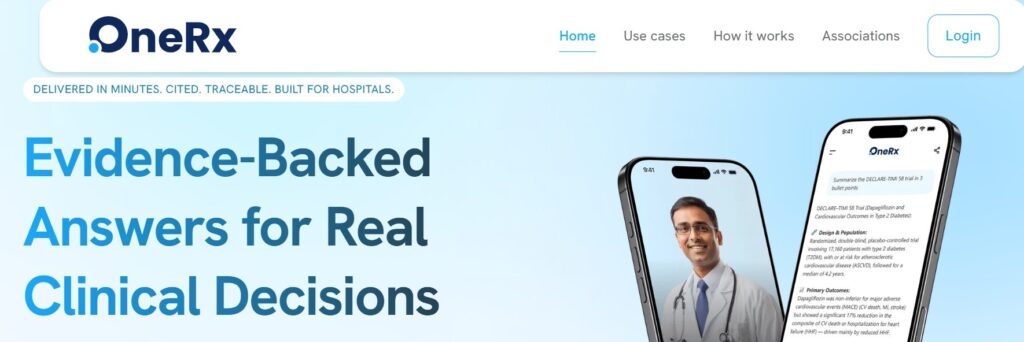
real-world clinical practice is where OneRx
plays a transformative role. OneRx is an Evidence AI platform designed
specifically for doctors, built to support evidence-based clinical
decision-making at the point of care. Its purpose is not to replace clinical
expertise, but to strengthen it by making trusted medical evidence accessible,
structured, and usable when it matters most.
The Challenge of Evidence-Based Medicine Today
Evidence-based medicine remains the cornerstone of
high-quality healthcare. It requires clinicians to combine their experience
with the best available scientific evidence. However, in practice, this ideal
is difficult to achieve consistently. The sheer volume of research, frequent
updates to clinical guidelines, and increasing complexity of diseases make it
nearly impossible for any single clinician to stay fully up to date.
In high-risk and rapidly evolving fields such as oncology,
this challenge is even more pronounced. New therapies, biomarker-driven
treatments, and changing staging systems demand continuous learning. As a
result, many clinical decisions rely on prior knowledge or fragmented sources
rather than the latest, most comprehensive evidence. This can lead to
variability in care, uncertainty during complex case discussions, and missed
opportunities to apply newer insights.
What Is OneRx?
OneRx is an AI-powered clinical decision support platform
built to address these exact challenges. It helps doctors access current,
validated, and structured medical evidence in a matter of moments. Instead of
searching through multiple journals, guidelines, or databases, clinicians can
rely on OneRx to surface relevant evidence aligned with their clinical
question.
Crucially, OneRx is designed with a responsible AI
philosophy. It does not generate unverified opinions or make autonomous
medical decisions. Every output is grounded in recognized medical literature
and guidelines, allowing clinicians to see where the information comes from and
how it applies to their case.
Evidence-First by Design
At the core of OneRx is an unwavering focus on evidence. The
platform brings together trusted medical sources and organizes them in a way
that reflects real clinical workflows. Rather than overwhelming doctors with
raw data, OneRx synthesizes information into clinically meaningful insights.
Key aspects of its evidence-first approach include:
- Structured
medical knowledge that connects clinical questions with relevant
research findings - Alignment
with established guidelines and staging frameworks, particularly in
oncology - Transparent
citations, enabling clinicians to trace recommendations back to their
original sources - Clear
differentiation between evidence and interpretation, preserving
clinical autonomy
This structured approach allows doctors to quickly
understand what the evidence says, how strong it is, and how it fits within
standard-of-care practices.
Focused Support for Complex Specialties
While OneRx is designed to be extensible across multiple
specialties, it has a strong focus on oncology, one of the most
evidence-intensive areas of medicine. Cancer care involves rapidly evolving
treatment paradigms, multidisciplinary collaboration, and high-stakes
decision-making.
OneRx supports clinicians by helping them evaluate treatment
options, understand evolving standards of care, and prepare for complex
discussions such as tumor boards. By consolidating evidence into a single,
accessible platform, it reduces uncertainty and supports more confident
clinical reasoning in challenging cases.
Designed Around the Doctor’s Workflow
One of the defining strengths of OneRx is that it is built for
doctors, not just for data analysis. The platform is designed to fit
naturally into clinical workflows, offering fast access to relevant information
without disrupting patient care.
Doctors can use OneRx to:
- Explore
evidence related to specific clinical questions - Review
therapeutic options with supporting data - Compare
approaches within the context of guidelines - Prepare
for multidisciplinary meetings and case discussions
By reducing the time spent searching and cross-referencing
information, OneRx allows clinicians to focus more on patient interaction and
decision-making.
Supporting Consistency and Confidence in Care
Variability in clinical decisions is a common challenge,
especially in large practices or hospital systems. OneRx helps address this by
providing a shared evidence foundation that clinicians can rely on. When
teams reference the same validated sources, it becomes easier to align
decisions, standardize care pathways, and reduce unwarranted variation.
Additionally, the traceability of evidence supports
accountability and confidence. Clinicians can explain and defend their
decisions based on documented, guideline-aligned evidence — an increasingly
important factor in modern healthcare environments.
OneRx in Hospital and Team Settings
Beyond individual clinicians, OneRx is also designed to
support hospitals and care teams. In institutional settings, it enables:
- Consistent
access to approved evidence across departments - Alignment
between individual clinicians and hospital protocols - Better
preparation for clinical committees and tumor boards - Improved
documentation of evidence-based decision-making
This makes OneRx a valuable tool not only for patient care,
but also for clinical governance, quality assurance, and risk management.
Responsible AI, Not Replacement
A key principle behind OneRx is respect for the clinician’s
role. The platform does not diagnose, prescribe, or replace human judgment.
Instead, it acts as a clinical support system, helping doctors make
better-informed decisions while remaining fully in control.
By clearly distinguishing between evidence presentation and
clinical decision-making, OneRx promotes safe, ethical, and responsible use of
AI in healthcare.
The Future of Evidence-Driven Care
As medicine continues to evolve, the role of AI will
increasingly be that of a clinical partner rather than an authority.
Tools like OneRx demonstrate how AI can be used to manage complexity, reduce
cognitive burden, and support better outcomes — without undermining
professional expertise.
By bringing evidence to the point of care in a structured,
transparent, and clinician-friendly way, OneRx helps bridge the gap between
research and real-world practice. It empowers doctors to stay current, make
confident decisions, and deliver care that is truly aligned with the best
available evidence.
In a healthcare landscape defined by complexity and constant
change, OneRx stands as a powerful example of how evidence-driven AI can
support doctors — and ultimately, the patients they serve.



 Written by
 Written by